Bush House | Where Oregon's Past Still Lingers
An old-world journey through history, architecture, and the quiet beauty of Bush's Pasture Park.
There is something extraordinary about entering a home where time seems to have slowed.
Not because the clocks have stopped, but because so much of what once made a house a home has been carefully preserved.
Tucked among the trees of Bush's Pasture Park in Salem, Oregon, stands an elegant Italianate home completed in 1878. Its tall windows, graceful porch, and intricate architectural details speak of another era.
But it was what I discovered inside that stayed with me.

A Home That Holds Its History
Bush House was built for Asahel Bush, a prominent figure in Oregon's early history, known for founding the Oregon Statesman newspaper and co-founding Ladd & Bush Bank.
Designed by Salem architect Wilbur F. Boothby, the home was completed in 1878, when Oregon was still a young state.
What makes this house remarkable is that it remained in the Bush family for generations.
Unlike many historic homes that have been furnished with objects collected from elsewhere, Bush House retains an extraordinary amount of its original furnishings, wallpaper, fixtures, and personal belongings.
As I wandered through the rooms, I found myself studying the details.
The beautiful marble fireplaces. The artwork adorning the walls. The rich woodwork carefully chosen furnishings.

Everything seemed to hold a story.
I was expecially drawn to the fireplaces. There is something about an old hearth that invites the imagination to wander.
How many winter evenings were spent beside those fires? How many conversations unfolded within these rooms?
A house may be built of timber and stone, but it is the lives lived inside that give it character.
A Farmstead in the Heart of Salem
One of the most interesting things I learned was that this elegant residence was also part of a working farm.
Long before the surrounding neighborhood developed, the Bush family property includes orchards, gardens, pastures, a barn, and a conservatory.
The household enjoyed many of the conveniences of its time, including indoor plumbing, gas lighting, and central heating.
Yet the land surrounding the home remained deeply connected to agricultural life.
I love imagining this landscape before the city grew around it.
The movement of animals through the pasture. Fruit ripening in the orchards. The rhythm of people tending gardens and preparing for the changing seasons.
The property was also maintained through the work of household staff and farm laborers, whose contributions were essential to daily life.
Today, the grounds have become a public sanctuary where people walk, gather, rest, and reconnect with nature.
Sally Bush and the Gardens She Loved
One of the stories that caught my attention was that of Sally Bush, Asahel's daughter.
Sally spent much of her life at the family home and was known for her love of gardening, animals, and quiet philanthropy.
She helped shape the landscape around the house, selecting plants and trees that contributed to the beauty of the estate.
I find something touching about that.
Long after the people who planted a garden have gone, their work can continue to offer beauty and shelter to others.
Perhaps that is one of the loveliest things we can leave behind.
Not simply possessions, but living things that continue to grow.

The Land Before the House
Of course, the story of this place began long before the Bush family arrived.
The land is part of the ancestral homeland of the Kalapuya people, whose relationship with the Willamette Valley stretches back thousand of years.
Remembering this brings a fuller understanding of the landscape and the many histories it holds.
Historic preservation offers us an opportunity not only to admire beautiful architecture, but also to examine the complexities of the past.
Where the Past Meets the Present
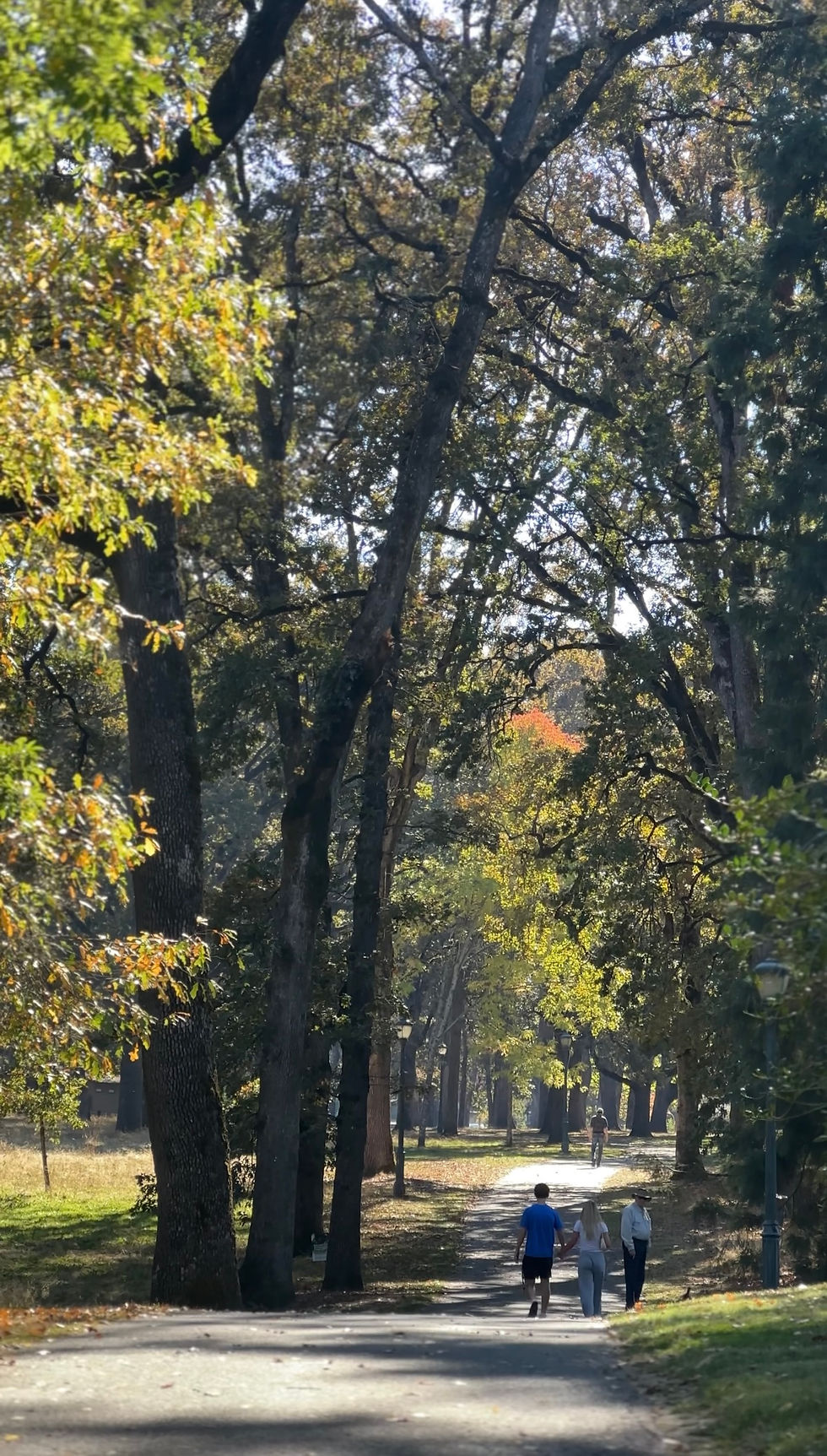
After visiting the house, I spent time walking through Bush's Pasture Park.
The grounds were peaceful, yet full of life.
People came and went along the paths. Others lingered quietly on benches beneath the trees.
And then there were the magnificent oaks.
Their great branches stretched outward like the arms of old guardians, offering shade to everyone who passed beneath them.
I grew up surrounded by oak trees in Northern California, and they have always felt like elders to me.
Seeing them here, beside a home that has stood for nearly a century and a half, brought a sense of continuity.
The house preserves one part of the story.
The trees preserve another.
And together, they remind us that history is not always something we encounter behind glass.
Sometimes it is alive around us, growing quietly with each passing season.
A Quiet Reflection
As I left Bush House, I found myself thinking about what it means to preserve something.
We often associate preservation with buildings, antiques, and historical artifacts.
But perhaps it is also about protecting the places where beauty, memory, and community meet.
An old home.
A garden.
A stand of ancient trees.
A peaceful bench where someone can rest for a while.
These places connect us to those who came before us, while offering something meaningful to those who will follow.
And perhaps that is why I am so drawn to old places.
They remind me that we are part of a much longer story.
May we continue to care for the places that carry our history, and may they remain places of beauty, reflection, and belonging for generations to come.
Wild Hawthorn | Oregon Field Notes
Visiting Bush House Museum
Located at 600 Mission Street SE in Salem, Oregon, Bush House Museum sits within Bush's Pasture Park. Visitors can explore the historic home through museum tours and enjoy the surrounding park grounds.
For current tour information, visit Bush House Museum.
Historical references: Bush House Museum, Salem Art Association, and Willamette Heritage Center.


Comments